Address
304 North Cardinal
St. Dorchester Center, MA 02124
Work Hours
Monday to Friday: 7AM - 7PM
Weekend: 10AM - 5PM
Address
304 North Cardinal
St. Dorchester Center, MA 02124
Work Hours
Monday to Friday: 7AM - 7PM
Weekend: 10AM - 5PM

In the world of metal manufacturing, surface finishing plays a crucial role in determining both the aesthetic appeal and functional performance of a product. Whether you’re producing aluminum die-cast parts, stainless steel components, or decorative metal pieces, the polishing stage directly affects product value, customer satisfaction, and brand reputation.
However, with the rapid development of automation, the range of polishing equipment available today is broader than ever. From manual machines to fully robotic polishing systems, choosing the right equipment can feel overwhelming.
At JiangMen Quanda Machinery Manufacturing Co., Ltd., with over 20 years of production experience and 30 years of polishing expertise, we’ve helped hundreds of manufacturers select and implement the most suitable polishing solutions for their products. In this guide, we’ll share professional insights to help you make a confident, informed decision.
The first step in choosing a polishing machine is to understand the type of material you’re working with and the final finish you want to achieve.
Each material reacts differently to pressure, heat, and abrasives. At Quanda Machinery, we customize machine parameters—including polishing wheel speed, feed rate, and force—based on the client’s specific materials and surface goals.
Not all machines can handle every shape. The geometry of your product determines the best type of polishing machine.
For products like panels, plates, and appliance covers, a surface polishing machine is ideal. These machines ensure even contact and consistent brightness across flat areas.
For pipes, handles, or metal bars, a tube polishing machine provides full 360° coverage and uniform gloss. These machines can be configured for round, square, or irregular tubing.
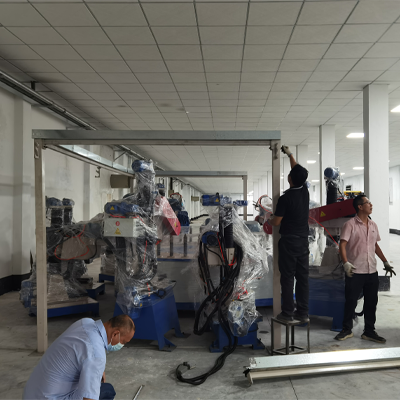
For die-cast or molded components (like automotive parts or faucet bodies), a CNC multi-axis polishing machine or robotic polishing workstation offers the best solution. The multi-axis design allows the polishing head to move precisely along complex curves and angles.
At Quanda Machinery, our engineers analyze product CAD drawings and create tailored jigs and fixtures to ensure accurate positioning and smooth operation during polishing.
Your production scale directly affects the type of machine you need.
If you manufacture small quantities or frequently change product models, a semi-automatic polishing machine may be the best choice. It’s flexible, easy to set up, and cost-effective for diverse applications.
For large-scale factories producing thousands of parts daily, fully automatic CNC or robotic polishing systems are the most efficient. They can run continuously with minimal supervision, ensuring consistent output and reducing human error.
Even if your production volume is small today, investing in modular equipment can prepare your factory for future growth. Quanda’s systems are designed with scalability in mind—you can start with one unit and easily expand to a multi-station robotic line later.
Different applications demand different finishing results—such as matte, satin, brushed, or mirror finish. The right polishing solution depends on both your quality standards and end-user expectations.
At Quanda Machinery, we test each client’s sample part in our workshop before production. This helps determine the best polishing wheel, abrasive, and machine configuration to achieve the desired outcome—saving time and reducing trial costs.
A good polishing machine should not only produce excellent results but also operate efficiently and reliably over the long term.
Quanda Machinery takes pride in offering lifetime technical support, comprehensive operator training, and a strong warranty policy to ensure every customer experiences worry-free operation.
A recent Quanda customer, a major aluminum die-casting manufacturer, faced serious bottlenecks due to manual polishing—low consistency, high labor cost, and long delivery times.
After a thorough analysis, our engineers designed a CNC robotic polishing solution featuring:
Results after installation:
This transformation not only improved profitability but also elevated the company’s reputation in the global market.
Price is always a concern, but focusing solely on the initial investment can be misleading. The true measure of a polishing machine’s value lies in:
Many of our customers recoup their investment within 6–12 months, thanks to labor reduction and improved output. When evaluating suppliers, consider the total cost of ownership, not just the purchase price.
When you choose JiangMen Quanda Machinery Manufacturing Co., Ltd., you’re partnering with a manufacturer that truly understands metal polishing from the inside out.
Our Advantages:
We don’t just sell machines—we deliver complete polishing solutions that help customers achieve higher productivity and superior surface quality.
The polishing industry is rapidly evolving toward smart automation and digital manufacturing. Future systems will combine robotics with artificial intelligence, automatically adjusting parameters based on real-time feedback.
At Quanda Machinery, we are actively developing next-generation polishing technology that integrates data collection, intelligent pressure control, and energy-saving designs—helping customers stay competitive in the era of Industry 4.0.
Selecting the right polishing machine is a crucial decision that directly impacts your production efficiency, product quality, and profitability. By carefully evaluating your material type, product shape, production scale, and finishing requirements, you can identify the solution that fits your factory’s needs.
At Quanda Machinery, we take pride in guiding our customers through this process with expertise and integrity. Our mission is to help every manufacturer—no matter their size—achieve smarter, faster, and more consistent polishing results through innovation and experience.
👉 Contact JiangMen Quanda Machinery Manufacturing Co., Ltd. today for a free consultation and customized solution design. Let’s work together to make your production line shine—literally and efficiently.